
What I Learned Marketing My Books on Social Media for the First Time
I’ve been an author for about six years.
For most of that time, I concentrated on what I assumed was the important part of being an author: writing books.
It turns out this was rather naïve.
Apparently, once you have written the book, edited the book, formatted the book, designed the cover, uploaded the book and spent several days staring obsessively at the book’s Amazon page, there is another small job you are expected to do.
Tell people it exists.
This is called marketing.
I had heard of it.
The uncomfortable world of self-promotion
I have spent most of my working life in technology, so I’m reasonably comfortable with computers, websites, analytics and the general principle of clicking buttons until something works.
Social media, however, is a different beast.
Posting occasionally on Facebook or LinkedIn is one thing. Deliberately making videos in which you appear on camera and say, essentially, Hello. I wrote a book. Perhaps you’d like to buy it, is quite another.
There is something deeply unnatural about self-promotion, particularly if you’re British.
We’re perfectly happy to spend two years writing 65,000 odd words and then, when somebody asks what the book is about, respond:
“Oh, you know. AI. Government. That sort of thing.”
This, apparently, is not an effective marketing strategy.
So, with Project Radiant published and more books in the Red Tape & Ruin series on the way, I decided it was time to make a proper attempt at social media.
Even LinkedIn
All places where millions of people happily film themselves speaking into their phones while I remain acutely aware that somewhere behind the camera is a pile of washing I forgot to move.
The first problem: what do you actually post?
This was the question that stopped me for quite a while.
Authors are constantly told that they need to “create content”.
Fine. What content?
Videos explaining what happens when artificial intelligence, government bureaucracy and corporate greed are allowed to spend too much time together without adult supervision?
That is admittedly, is fairly close to my normal subject matter.
The problem is that social media seems to reward consistency. You cannot wander onto TikTok once every three months, announce that you remain an author, and then disappear back into your manuscript.
Or perhaps you can. It just isn’t terribly effective. I needed something I could post regularly. And then I realised I already had it.
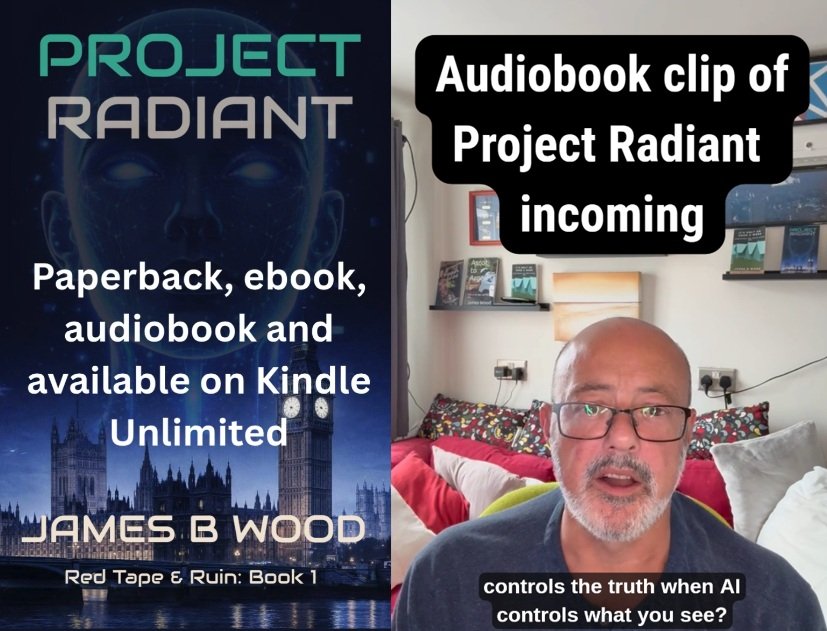
The audiobook
Project Radiant had recently been turned into an audiobook, narrated by Clare Saxby.
Listening to somebody else perform characters that previously existed only inside your head is a very strange experience.
A good one. But strange.
The narrator notices rhythms in the dialogue that you hadn’t consciously realised were there. Jokes land differently. Serious passages become more serious. Characters develop voices.
And suddenly I had hours of professionally narrated material sitting there.
Which led to an idea.
What if I posted the audiobook one chapter at a time?
Not entire chapters in each video, obviously. Social media platforms would probably regard a forty-minute TikTok as some form of hostage situation.
Instead, I could take a short extract from each chapter and post one every day.
Day One: Chapter One.
Day Two: Chapter Two.
Day Three: Chapter Three.
And so on.
A tiny serialised version of the novel.
One chapter. One clip. Every day.
What appealed to me was its simplicity. I didn’t have to invent thirty entirely unrelated pieces of promotional content. The book already had a structure. So I decided to use it.
I could then try to batch create a short video for each day. I select a short section from the next chapter of Project Radiant. Something intriguing, funny, dramatic or occasionally slightly disturbing.
I add a brief introduction, or not depending the feedback I got from my 16 daughter.
Then I let Clare’s narration do the work.
The clips range from Sarah Perriam investigating increasingly troubling uses of AI, to government meetings, corporate manoeuvring, surveillance teams and the Sovereign AIs themselves.
Some clips contain important plot moments. Others are simply passages I like. And some are there because they make me laugh.
One of my favourites involves a surveillance van parked opposite a café bearing the supposedly inconspicuous words HERTS PLUMBING & HEATING, while the surveillance officers inside complain about thermoses, newspapers and stiff joints.
It probably tells you quite a lot about the tone of the book.
The difficulty of three seconds
One thing I’ve learned very quickly is that writing a novel and making a short-form video require almost opposite skills.
A novel can spend pages creating atmosphere. TikTok gives you about three seconds.
You quickly start thinking in terms of hooks.
What would happen if the AI running the country decided humans were the problem?
The government thought it controlled the AI. It was wrong.
This surveillance operation would be much more impressive if everyone wasn’t complaining about their knees.
The objective isn’t to explain the whole chapter. It is to make someone stop scrolling for long enough to become curious.
That is a surprisingly difficult form of writing. I’ve spent years worrying about opening paragraphs. Now I’m worrying about opening seconds.
And then there are the algorithms
Naturally, because I write books about technology controlling people’s lives through systems nobody quite understands, I have now voluntarily placed myself at the mercy of several algorithms nobody quite understands.
There is a certain symmetry to this. You post a video. TikTok shows it to some people. Or perhaps it doesn’t. Instagram may like it. YouTube may suddenly discover it three days later. Facebook may decide that precisely fourteen people should see it, twelve of whom appear to be relatives.
Then another clip that you almost didn’t post inexplicably performs far better.
Naturally you begin analysing everything.
Social media marketing appears to involve just enough data to convince you there must be a rational explanation while carefully withholding enough information to ensure you never actually find it.
As someone who has spent years working in technology, I find this reassuringly familiar.
The temptation to chase numbers
There is also a trap here. Views are extremely visible. Books aren’t.
When you write a novel, progress is slow. Thousands of words. Months of editing. Eventually publication.
Social media gives you numbers almost instantly. 347 views. 1,200 views. Twenty likes. Three comments. Another follower.
It is dangerously easy to start treating those numbers as the objective. But they aren’t.
I’m not actually trying to become a TikTok influencer. Nobody needs to see me reviewing moisturiser or haircare products. The aim is much simpler.
I want to find readers who might enjoy my books.
If someone listens to thirty seconds of Project Radiant, laughs at a line, becomes curious about Sarah Perriam and eventually decides to read the novel, the exercise has worked.
Even if the video didn’t “go viral”.
Something unexpected happened
The audiobook clips have also made me look at the novel differently. When you isolate thirty or forty seconds from a chapter, you start noticing what really characterises the book. Not necessarily the big plot points. The little moments. A sarcastic exchange. A ridiculous piece of corporate language. An AI saying something alarmingly reasonable.
A bureaucrat trying to describe catastrophe without using a word that might upset the minister.
Those small moments probably communicate what Red Tape & Ruin is better than a traditional advert ever could.
Yes, they’re technology thrillers.
There are conspiracies, artificial intelligence, surveillance, government failures and some fairly serious questions about who gets to control increasingly powerful technology.
But they’re also supposed to be funny. Usually because the most absurd part of technology isn’t the technology, It’s us.
So, is social media marketing working?
Ask me again in a few months. I’m still experimenting.
I’m trying different introductions, hooks, captions, platforms and formats. Some things work better than others. Some things I think will work brilliantly sink without trace.
But that’s becoming part of the fun. For six years I concentrated mostly on writing books. Now I’m learning how to talk about them in front of a camera.
And for the moment, posting Project Radiant chapter by chapter feels like a rather nice way of doing it.
Instead of repeatedly telling people:
Buy my book.
I can say:
Here. Listen to this bit.
If you enjoy it, there’s plenty more where that came from. And tomorrow I’ll post the next chapter.
Assuming, of course, the algorithm allows it.