
The Myth of the Perfect First Draft
Somewhere along the line, new writers were sold a spectacularly unhelpful lie: the idea that a first draft should emerge fully formed, like a flawless literary diamond sparkling with genius and smelling faintly of accomplishment. According to this myth, you sit down, flex your fingers, and poof! out pours a masterpiece worthy of awards, adoration, and possibly a small parade.
Reality, of course, has other plans. What usually emerges is something closer to a pile of drunken scribbles held together by misplaced enthusiasm, half-formed thoughts, caffeine, and the faint hope that Future You will know what Past You meant by “this bit is important!!!”. It is chaotic. It is messy. It occasionally violates several laws of logic. And that’s exactly how it’s supposed to be.
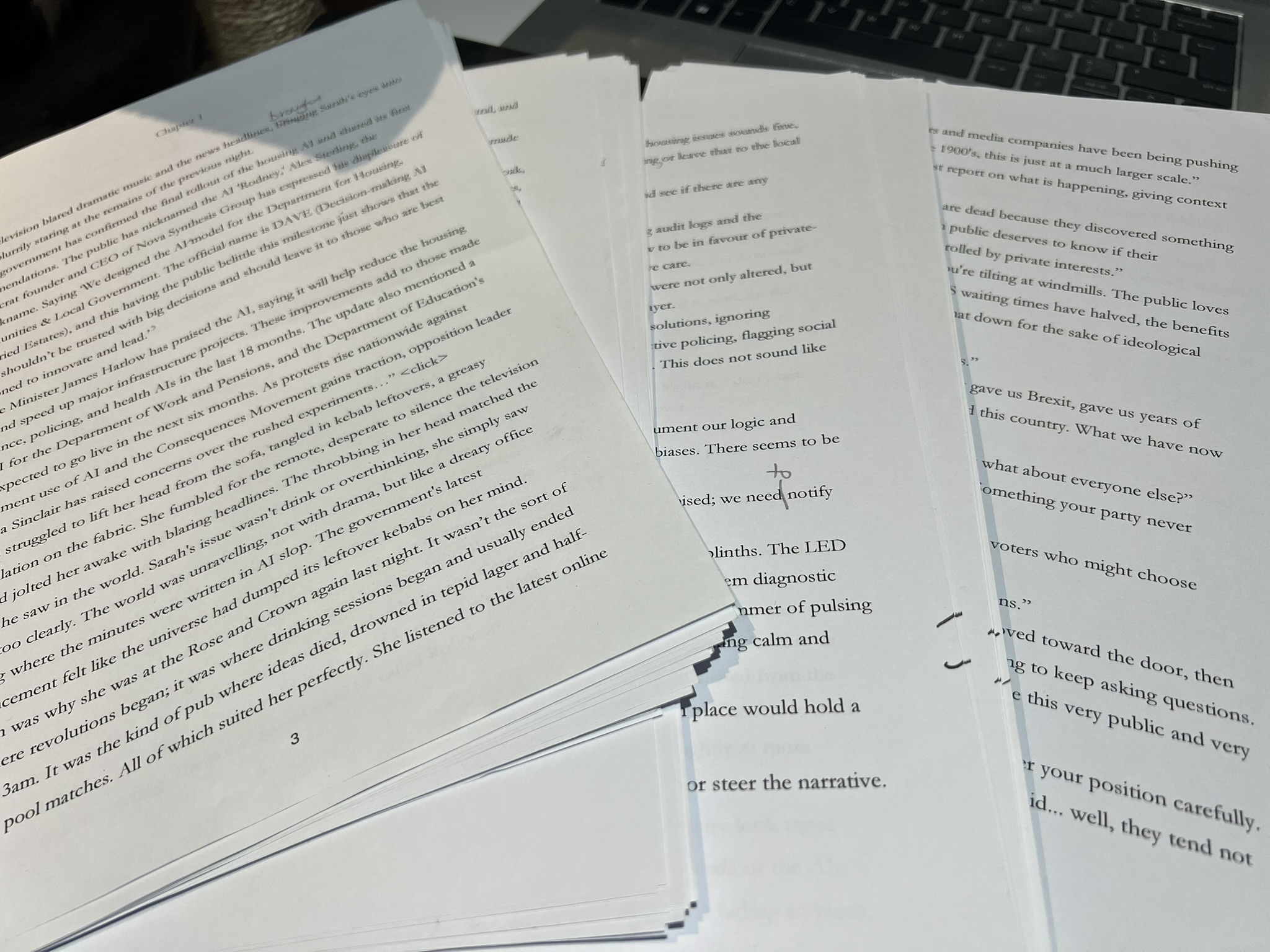
A first draft is not meant to be perfect. If anything, it should proudly be a glorious mess, rambling, incomplete, contradictory, and sometimes entirely incoherent. Think of it not as building the cathedral itself, but as tossing together the scaffolding at three in the morning with wonky planks and questionable engineering. You’re allowed to use mismatched beams. You’re allowed to forget a window. You’re absolutely allowed to leave notes like “fix this later,” “add emotional depth (lol),” or my personal favourite, “insert dramatic scene here, idk.”
Why? Because perfectionism is the single greatest enemy of progress. When you aim for brilliance on the first try, you freeze. The pressure builds. Your inner critic, who has been suspiciously quiet until now, leaps onto the stage, taps the microphone, and announces, “You really think that’s good enough?” And suddenly writing, formerly a creative act, feels like a trap with no exit.
But the moment you accept that the first draft is merely an exploration, everything begins to loosen. Words flow more freely. You write faster. You take risks. You allow the story to discover itself instead of forcing it to follow a rigid outline that may or may not collapse by chapter three like a badly assembled IKEA wardrobe.
This is where the magic hides. The first draft is not the book; it is the raw material of the book. Revision is where your scattered ideas become sharp, your prose becomes elegant, your foreshadowing stops accidentally spoiling things, and your characters finally stop sounding like malfunctioning robots trying to simulate human speech. Editing is transformation. The draft is just the starting point.
So embrace the imperfection. Write scenes that go nowhere. Introduce characters you might later fire. Invent plot twists you may gleefully delete. Let your story wander like a confused tourist armed only with enthusiasm and a questionable map. You can clean it all up later, future you will sigh deeply, roll up their sleeves, and handle it.
The first draft isn’t meant to impress anyone. It isn’t meant to be shown off. Its only job is to exist—to take your idea from “vague notion floating in the ether” to “messy thing that can now be shaped, improved, and eventually adored.”
And existence, in writing, is half the battle won. The rest is revision, persistence, and the occasional cup of very strong tea.